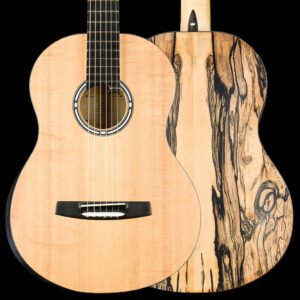
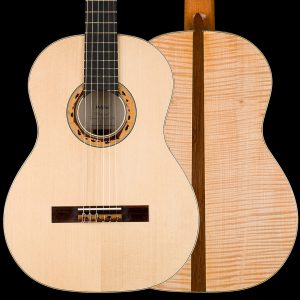
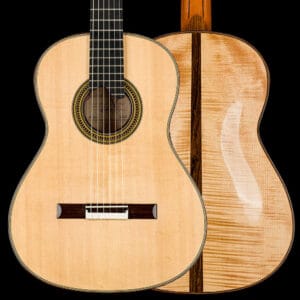
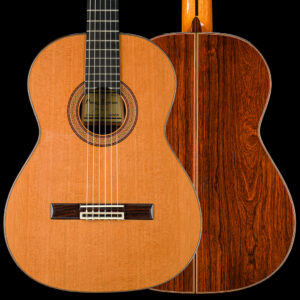
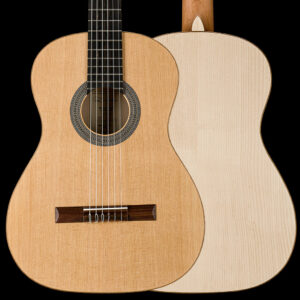
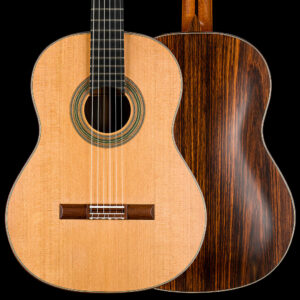
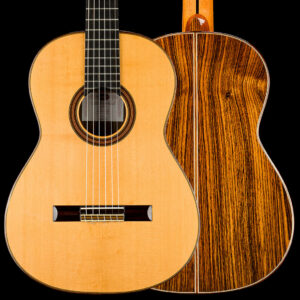
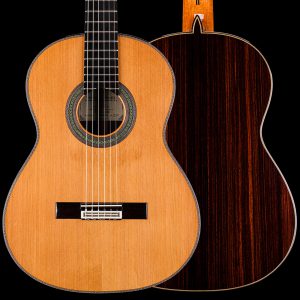
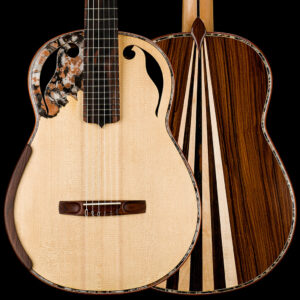
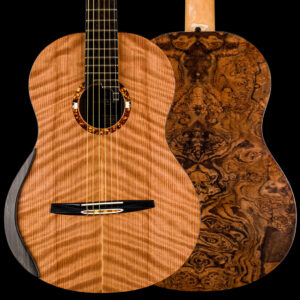
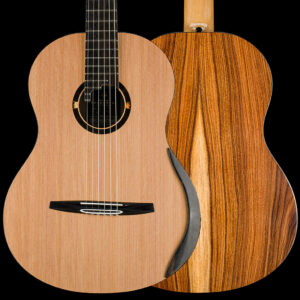
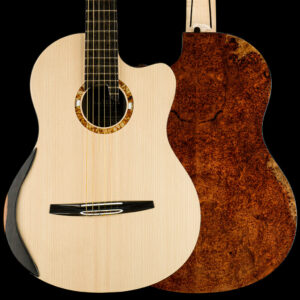
Here we present the finest handcrafted classical guitars for discerning classical guitarists looking for unique tone and craftsmanship. “Our” luthiers (Turkowiak, Souza, Sedlacek) can also make any guitar especially for you on custom order so you can specify any detail to suit your liking. Most of the classical guitars in our store have a demo video recorded so you can watch our classical guitars on youtube. Don’t hesitate to ask for live online presentation of any of our guitars – just call us or drop us an email.
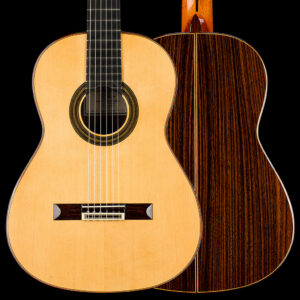
2,070 €
We understand that buying a concert classical guitar is a BIG decision. To make it the easyest ever we give you 14 days to decide if you want to keep the guitar you bought from our guitar store at happyguitar.eu. With no questions asked you can just send the guitar back to us in unchanged condition and we will give you a full refund. Please remember that shipping costs will not be refunded. You can not return a guitar which was made on your custom order or modifyed on your request (eg pickup installation). Call us if you have any doubts.
The classical guitar as we know it today was designed by Antonio de Torres Jurado (1817-1892) around year 1850 in Sevilla. His guitar combined all the best solutions present at that time in instruments preceding “the guitar” (viola da mano, vihuela, four/five/six course guitar, six string guitar), but he also made some his own inventions like bridge saddle (before that a bridge and a saddle used to be combined in one piece of wood). He replaced the transverse bracing strengthening the top from the inside of the sound box with radial bracing around the soundhole – now we call it a fan bracing. He also declared that the top of the guitar is the most important part when it comes to the sound of a guitar, so he extended it making the guitar bigger. Those guitars by Torres which survived have spruce tops and bobies made from rosewood (mainly) or maple (like his guitar form 1883). Torres in 1862 built a guitar which body was made of paper mass (papier-mache) to present the importance of the top and its bracing system to the guitar tone. After Torres more fine luthiers continued to built guitars in his tradition: Francesco Gonzalez (the teacher of Jose Ramirez I), Vicente Arias, Jose Ramirez I, Santos Hernandez, Francisco Simplicio, Domingo Esteso, Marcelo Barbero, Hermann Hauser, Ignacio Fleta to mention just a few. Most of the were Spanish hence this instrument was widely known as spanish guitar.
An interesting note is that guitar tops were traditionally build almost exclusively from spruce, it was Jose Ramirez III who popularized cedar tops very liked by Andres Segovia himself. Nowadays wide range of wood kinds are used in classical guitar building. While cedar and spruce make the tops with a rare usage of other kinds like redwood, the guitar body can be made of rosewood, maple, walnut, ziricote, ebony, redwood, cypres, olive and more.
Classical guitar neck in most cases is made of cedar, often reinforced with a central band of ebony, or other stiff materal, to prevent warping (an invention of Jose Ramirez III) and only in rare cases of other kinds of wood like sycamore for example (ex. Turkowiak). The ebony stripe is not always visible – it can be placed inside the neck from the “upper” side – next to the fretboard. Classical guitar neck usually is not equipped with a truss rod (unlike acoustic guitars) but there are exceptions like A. Manzano A400 model.
If we would have to find just one person with the greatest impact on guitar music, many would point to Francisco Tarrega (1852-1909). This Spanish guitar virtuoso and composer has left enormous amount of his original guitar compositions but also plenty of guitar transcriptions of masters like J.S. Bach, Fryderyk Chopin, Issac Albeniz, Ludwig van Bethoven as well as his own guitar method. Tarrega’s pieces are widely played all around the world by advanced and novice players alike. His pieces Requerdos de la Alhambra and Capricio Arabe are still the high spots of every guitarist’s repertoire. He used to play a guitar made by Antonio de Torres (founded by a wealthy merchant Antonio Canesa) and worked as a guitar teacher – Miguel Llobet was one of his most famous pupils. Francisco Tarrega is ofthen called “a father of a classical guitar” and put among the greatest guitarists in history.
Fine classical guitar requires some care and attention from you to preserve its health, sound to last for decades. Keeping your guitar withing an appropriate humiduty range (45-55%) is especially crucial. You will find extended info on thos subject in our Guitar Care Guide.
The classical guitar, a staple in the world of music for centuries, is a versatile and expressive instrument. When we talk about a “concert guitar,” we’re referring to a classical guitar crafted specifically for professional performance. This distinction hinges on several critical factors that elevate a standard classical guitar to concert status, involving craftsmanship, materials, sound quality, playability, and aesthetics. Here’s a closer look at what makes a classical guitar a concert guitar.
Concert classical guitars are typically handmade by master luthiers, whose skill and experience play a crucial role in the instrument’s quality. These artisans often spend hundreds of hours meticulously crafting each guitar, ensuring that every detail enhances the instrument’s performance. The precision in construction, attention to detail, and adherence to time-honored techniques set these guitars apart from mass-produced models.
The choice of materials significantly influences the sound and longevity of a concert guitar. High-quality tonewoods are essential:
Soundboard: Typically made from spruce or cedar, the soundboard is the most critical component affecting tone and projection. Spruce provides a bright, clear sound with great projection, while cedar offers a warmer, more mellow tone.
Back and Sides: Commonly crafted from rosewood, mahogany, or maple, these woods contribute to the guitar’s resonance and tonal complexity.
Fingerboard and Bridge: Ebony and rosewood are popular choices for their durability and smooth playing surface.
A concert guitar is expected to deliver exceptional sound quality, characterized by clarity, balance, and projection. The sound should be even across all registers, from the deepest bass to the highest treble notes. Concert guitars often have a rich, complex tonal palette, allowing for a wide dynamic range that responds well to the nuances of a performer’s touch.
For professional guitarists, playability is paramount. Concert guitars feature:
Optimal Action: The string height (action) is carefully set to ensure ease of play without sacrificing sound quality. Too high, and it becomes difficult to play; too low, and it may buzz. Neck Profile and Width: The neck is shaped to facilitate comfort and dexterity, often tailored to the guitarist’s preferences.
Fretwork: Precision in fret installation and finishing ensures that notes play cleanly and intonation is accurate up the neck.
While sound and playability are paramount, the visual appeal of a concert guitar is also significant. These instruments often feature:
Elegant Inlays: Detailed inlays on the rosette, fingerboard, and headstock showcase the luthier’s artistry.
High-Quality Finish: A thin, durable finish, such as French polish or a fine lacquer, protects the wood without dampening its resonance. This enhances the guitar’s appearance and allows the wood to age gracefully.
Many concert guitars are custom-made or personalized to suit the specific needs and preferences of the guitarist. This could include adjustments in the body size, scale length, neck shape, and even aesthetic details. Such customizations ensure that the instrument feels like an extension of the performer, contributing to better performance and greater expression.
A concert classical guitar requires regular professional setup and maintenance to ensure it performs at its best. This involves periodic adjustments to the action and sometimes the bridge saddle to compensate for changes in humidity and temperature, which can affect the wood.