Classical vs Flamenco guitar

how to tell them apart

Classical vs flamenco guitar

Distinguishing between flamenco vs classical guitar can be challenging if you’re unsure where to focus your attention. Both instruments are acoustic guitars, typically equipped with nylon or carbon strings, and they may appear quite similar, especially to someone new to the world of guitar playing.

While it’s relatively easy to identify an acoustic guitar from a classical one by examining the fretboard, discerning between classical and flamenco models requires a deeper understanding. You’ll need to familiarize yourself with guitar construction, tonewoods, and, most importantly, the distinctive tones each type produces.

In this discussion, we’ll delve into the differences and similarities between these two guitar types, helping you differentiate between them and providing insights for selecting the right instrument for your needs

Graciliano Perez flamenco guitar "mxta"

Flamenco guitar "negra" with transparent golpeador (Perez)

Flamenco playing with a lot of golpe

The primary distinctions between classical and flamenco guitars arise from their intended purposes. Classical guitars are designed primarily as solo instruments for performing classical music. They should offer a sound that is clear, full, loud, rich in harmonics, and with substantial sustain.

In contrast, flamenco guitars are crafted with the specific task. Their work is to accompany flamenco dancers and singers, often emphasizing aggressive and loud tones. The characteristic sound of flamenco guitars may even include a deliberate amount of string buzz, depending on the player’s preferences. Additionally, flamenco players frequently employ percussive techniques by tapping the guitar’s top with their fingers, known as ‘golpe.’

One key difference between flamenco and classical guitars lies in the string height over the fretboard. Classical guitars typically have higher string action to prevent any buzzing. Flamenco guitars often feature lower string action, as some degree of buzz is not only acceptable but desirable.

To facilitate the production of percussive effects, flamenco guitars also have lower string height over the guitar top, resulting in a significantly lower bridge compared to classical guitars. The strings’ height over the top of a flamenco guitar near its bridge typically ranges between 5 and 8mm, whereas on a classical guitar, this measurement is usually much higher, around 10-13mm.

To protect the top of the flamenco guitar from damage caused by fingernails during percussive playing, a protective plate called a ‘golpeador’ is often applied. This plate, typically made of transparent plastic in modern instruments, can take the form of a single plate or two plates positioned under and over the soundhole. Vintage flamenco guitars may feature golpeadors made of white or black material.

The presence of the golpeador serves as the most obvious and initial distinguishing feature of a flamenco guitar.

Flamenco guitar "blanca" Cabanillos

Tonewoods and Materials

Guitar tops Tops of flamenco and classical guitars are maid mainly from spruce and cedar – so here is no difference between them.Guitar bodyThe exploration of guitar body materials adds an intriguing dimension to the comparison between classical and flamenco guitars. In this realm, the range of tonewoods expands significantly. Both classical and flamenco guitars can feature bodies crafted from various rosewoods, with Indian rosewood being the most prevalent. While Brazilian rosewood is often hailed as the pinnacle of tonewoods, its scarcity due to harvesting restrictions has led to its replacement by Indian and Madagascar rosewoods.The distinction between classical and flamenco guitars is further elucidated by the categorization of flamenco guitars into “blanca” and “negra” types. The ‘blanca’ represents the fundamental form of the flamenco guitar and is characterized by a body crafted from cypress, a bright-toned wood, hence the name ‘blanca.’ In contrast, the ‘negra’ can be constructed from a variety of dark-toned woods, including Indian or Madagascar rosewoods, as well as pau ferro, grenadillo, cocobolo, among others.Originally conceived as a percussive accompanying instrument, the ‘blanca’ is typically more affordable than the ‘negra,’ as cedar, often used in its construction, is less expensive than the darker tonewoods. However, as flamenco playing techniques evolved and the flamenco guitar transitioned into a fully solo instrument, the need for a more resonant and melodious instrument arose, giving rise to the ‘negra’ with its harder, darker tonewoods, providing enhanced sustain and projection capabilities.It’s important to note that the body of a classical guitar is never crafted from cypress, thus dispelling the notion that any bright-looking guitar is necessarily a flamenco guitar. Classical guitars often utilize maple, another bright-toned wood, making it imperative to distinguish between these tonewoods when identifying a flamenco guitar solely based on appearance.Additionally, flamenco guitars typically feature shallower bodies compared to classical guitars, further contributing to their distinctive sound and playing characteristics.

For more info about spruce and cedar guitar tops refer to our Guitar top: spruce or cedar – neverending debate .

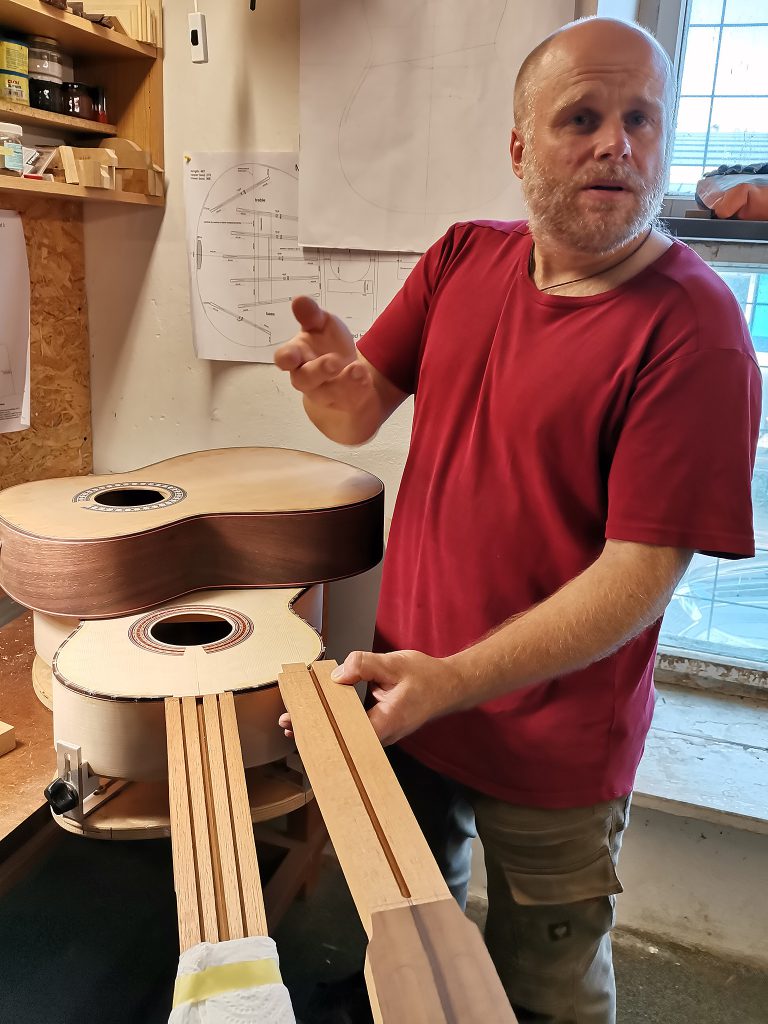
Flamenco and classical guitar neck construction explained by Lukas Sedlacek.

Neck construction

To get a shorter sustain on a flamenco guitar, the neck can be constructed completely differently than the neck of a classical guitar. In the case of a classical guitar, the longer sustain, the better, which is why special, hard reinforcements or a special construction are used (like acoustic tubes in Turkowiak guitars). The neck of a flamenco guitar should be less rigid, which can be achieved by removing some of the wood or using more flexible reinforcements. In the next photo, Mr. Sedlacek shows us and explains the difference between the neck of a flamenco guitar (left) and a classical guitar (right).

Andalusian Guitars flamenco guitar

Is It Possible to Play Flamenco on a Classical Guitar?

As classical guitars do not have golpeadors so playing flamenco music can damage your guitar quite quickly. Of course, you can play some phrases, chords but you should avoid any percussive effects.
The opposite approach is more reasonable – playing classical music on a flamenco guitar. It can work especially with the flamenco guitar of the Negra type due to the better decay and fuller sound of such a guitar. If you want to reduce the buzzing of the frets, you can set the strings of your flamenco guitar a little higher – this way your Flamenco Negra guitar can become quite a versatile instrument. This solution is not perfect, but it can be used if necessary.

Conclusion

The differences between classical guitar and flamenco guitar are sometimes very subtle, but they become more and more important as the guitarist progresses. The basic pieces can be played on either of the two types of guitar, while for an increasingly advanced repertoire, these small differences determine whether that piece can be performed and sounded the best. If you specialize in classical or flamenco music, you need a suitable, specialized instrument. If you want to have a guitar with nylon strings at home to play a few chords from time to time and don’t know what you’ll be playing in the future, we recommend a Negra type of flamenco guitar with the strings set a little higher and enjoy a fairly versatile instrument.

Weather you prefer classical or flamenco guitar don’t forget to chcek our Guitar Care Guide. You can read much more about classical guitar strings in our Classical Guitar Strings Guide

Our flamenco guitars

  • Turkowiak double-top flamecno guitar no 738

    Turkowiak double-top flamenco guitar No 738 – Opus Prime

    6,100 
  • Flamenco guitar by Prudencio Saez 2-FP
    VIDEO

    Prudencio Saez 2-FP flamenco guitar

    795 
  • Turkowiak Flamenco Guitar Blanca Opus Virtuoso No 664 -True Temperament

    Turkowiak double-top flamenco guitar No 664 – Opus Virtuoso

    6,200 
  • Flamenco guitar Hermanos Camps model "Concierto"

    Hermanos Camps flamenco guitar “Concierto”

    4,320 
  • Flamenco guitar by Teodoro Perez "Estudio"

    Flamenco guitar Teodoro Perez “Estudio” blanca

    2,070 
  • Flamenco guitar by Juan Marin
    PRE-OWNED

    Flamenco guitar Juan Antonio Correa Marin (2016)

    2,290 
  • Flamenco guitar Martinez y Cortes
    SOLD

    Martinez y Cortes flamenco guitar “blanca” 1a (2023) – sound sample

    Out of stock

  • Flamenco guitar by Samuel Zamfir de Souza
    VIDEO

    Flamenco guitar Samuel Zamfir de Souza #20 2022

    3,345 
  • Flamenco guitar by Miguel Mateo 2023

    Flamenco guitar Miguel Mateo “La Chula” 2023

    3,700 
  • Flamenco guitar Hermanos Camps Primera Negra E
    VIDEO

    Hermanos Camps Primera Negra E flamenco guitar (2024) – amplified

    1,980 

Our classical guitars

  • This classical guitar by Paula Lazzarini is her modern “Australian” model with an elevated fingerboard, a cedar soundboard, and lattice bracing.

    Paula Lazzarini classical guitar “Lattice” 2026

    5,600 
  • Classical gutiar by Michele Della giustina no 434 doub.e-top
    VIDEO

    Michele Della Giustina double-top classical guitar #434

    6,500 
  • Classical guitar by Gerardo Centonze – an Italian master luthier. This guitar features a spruce top and an Indian rosewood body and offers a great, open sound.

    Gerardo Centonze classical guitar “Concerto” 2026

    6,300 
  • Classical guitar by Marco Maguolo - model Ducale 311
    VIDEO

    Marco Maguolo classical guitar Ducale #311 (REG2025)

    7,600 
  • Classical guitar by Lorenzo Masini No 8
    VIDEO

    Lorenzo Masini classical guitar #3 (2023)

    4,300 
  • Double-top classical guitar by Stanislaw Partyka 640mm scale
    VIDEO

    Stanislaw Partyka double-top classical guitar 640mm (2025)

    4,350 
  • Handcrafted Turkowiak Opus Prime #737 crossover guitar with double-top spruce/cedar, amara ebony body and unmatched tone & playability.

    Turkowiak double-top crossover guitar #737 Opus Prime

    5,800 
  • Classical guitar by Sebastian Lenartowicz No 9

    Sebastian Lenartowicz classical guitar No 9

    2,600 
  • Classical guitar Carlos Diaz Miranda No 6
    VIDEO

    Carlos Diaz Miranda classical guitar #6

    2,820 
  • Perfectly crafted double-top classical guitar by Vasilis Vasileiadis with a powerful yet traditional sound. Features a sspruce/cedar top and ziricotte body.

    Vasilis Vasileiadis double-top classical guitar: 237

    5,500 

Playing examples:

Flamenco guitar playing

Classical guitar playing

Free worldwide shipping for any purchase over $3000 with code

till the end of august