


Classical Guitar Strings
The Complete Guide for Discerning Guitarists
Why is the choice of strings so important?
Strings are one of the most important elements shaping the sound of a classical guitar. Even the best instrument will not sound its best if the strings do not harmonise with its construction. Their selection affects the tone, volume, articulation, dynamics and comfort of playing. The right strings also allow you to slightly adjust the sound character of the guitar to suit your preferences.
Choosing strings is not a trivial matter – the available materials, types and tensions can be overwhelming at first, but well-chosen sets allow you to bring out the full potential of your instrument. In this guide, you will find the history of strings, their types, as well as practical tips on how to choose and use them.

History and materials of strings
Nylon strings – a classic of the genre
Most modern classical guitar strings are made of nylon. The treble strings (1, 2, 3) are made from a single transparent nylon strand, while the bass strings (4, 5, 6) consist of nylon (formerly silk) fibres wrapped in copper or silver wire, sometimes in combination with other metal alloys.
Specific nylon blends give the sets their unique character and are closely guarded by manufacturers. Traditionally, before the era of nylon, strings were made from animal gut (catgut), horsehair, silk or plant fibres, depending on the region. Nylon gained popularity during World War II when gut resources were used in the surgical industry. The breakthrough came with the work of Albert Augustine in collaboration with Andrés Segovia, which led to the creation of modern nylon strings.
Carbon strings (fluorocarbon)
Carbon strings (PVFD, fluorocarbon) are a modern alternative to nylon. They are characterised by a bright, clear sound, reminiscent of gut strings, with better projection in concert halls. They provide a clearer attack and greater precision of articulation.
Titanium strings
RC Strings has developed its own Titanium material, which offers a sound between nylon and carbon. This is a solution for guitarists who want to brighten the sound slightly while retaining the warmth of nylon strings.

String tension – how to choose it?
Choosing the right string tension is a key factor affecting the sound and comfort of playing.
- Low tension – comfortable, subtle, puts less strain on the soundboard. Recommended for older guitars or for people with hand joint problems who need an exceptionally soft guitar.
- Normal tension – the most versatile. Provides a good balance between dynamics, comfort and stability.
- Medium-high tension (medium-hard) – slightly harder than standard strings but offering greater volume than standard strings.
- High tension (hard) – greater volume, stronger attack, but also higher tension on the neck and fingers.
🎯 Tip: Generally, the more you play and the more regularly you play, and the better condition your hands are in, the harder the strings you can try. ‘Sunday’ guitarists prefer standard or soft strings, while professionals often use hard strings.
🎯 Luthier’s tip: if you have a guitar with a thin soundboard (e.g. modelled on Torres), choose medium or low tension sets. Harder tension can make the soundboard too stiff, which worsens the sound of the instrument.
Choosing strings for a classical guitar
Treble and bass strings are different stories
Treble and bass strings should be considered separately. Different types of strings come in different configurations. For example, Knobloch EDC and ADC sets consist of identical treble strings but differ in bass strings (Actives vs Erithacus). Another example is Savarez strings, where Alliance treble strings can be ‘paired’ with Corun, Cantiga or HT Classic bass strings.
Choosing strings
Each guitar reacts differently to a change of strings. Strings that sound great on one instrument will not necessarily be the best for another guitar. It is worth testing different materials and degrees of hardness until you find the best combination for your instrument.
First, it is important to determine what strings are currently on your guitar so that you have a point of reference. If you have purchased a guitar and do not know what strings are on it, you can change them immediately or use them up before replacing them. We recommend keeping the label from the new strings in the guitar case in case you forget what you have put on. After a few days of playing with the new strings, consider whether you want to stick with this sound or adjust it, and in which direction.
The sound of the guitar can be brightened by changing the violin strings to Titanium or Carbon. The sound becomes softer when we change the strings from Carbon to nylon, and an even softer sound is offered by the BI Nylon (Knobloch), Luna FLamenca (Knobloch), Leo Brouwer AT Nylon (Knobloch) or Alabastro (Aguila) sets offer an even softer sound.
Bass strings: bright basses are Actives (Knobloch) and Cantiga (Savarez). Softer, fuller basses are Erithacus (Knobloch) and Sterling Silver (Knobloch)
For advanced players
In practice, it often happens that our guitar sounds best with nylon strings except for the G string, which can be too mellow and at the same time a little too thick. A popular solution is to replace the nylon G string with its carbon counterpart. You can purchase a single G string or a ready-made set with a ‘replaced’ G string with carbon, e.g.: RC Strings SRR50 Víctor Monge Serranito classical guitar strings, medium tension
Recorded audio or video samples make it easier to compare sets and track changes in the sound of the instrument. After a few weeks of testing, you can choose your favourite sets and consider availability and price.
Our recommendations

These are some of the most popular strings in our shop. For many guitarists, they are the ideal starting point in their search, and some of them stick with them permanently – simply because they sound great. They give the guitar a clear, bright and resonant sound without making it difficult to play.

The bass strings in this set are made of pure 925 silver, offering the best bass quality with exceptional depth and sound selectivity.

Knobloch Erihtacus EDQ33.5 Nylon Medium Tension
A high-quality set of nylon strings with a classic, traditional sound. If you are unsure which strings to choose, start with these.
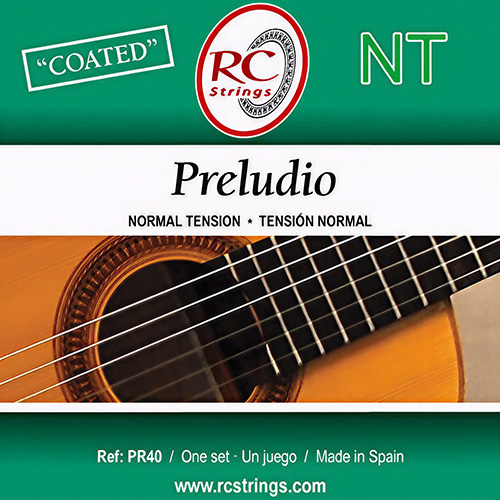
RC Preludio PR40 Medium Tension
The Spanish RC Preludio strings are an economical and basic set of strings for everyday intensive use, offering extended durability and great sound.
FAQ
Most frequent questions and answers
How often should strings be replaced?
Strings retain their full sound for about 100 hours of playing, which corresponds to approximately one month of intensive learning or 4–5 months of occasional playing. If you have a concert, competition or recording coming up, it is worth putting on a new set about 5 days beforehand so that the strings have time to “settle” and achieve their optimal sound.
What strings should I choose for my classical guitar when starting out?
When starting out, it is best to choose normal tension nylon strings – they are comfortable, gentle on the fingers and provide a warm, classical sound. A good choice would be sets from brands such as Knobloch, Royal Classics or Luthier from their beginner series.
Can I put metal strings on a classical guitar, like those used on an acoustic guitar?
Absolutely NOT! Metal strings, designed for acoustic guitars, require much greater tension than nylon strings for classical guitars. Classical guitars are not designed to withstand such high tension. Putting metal strings on a classical guitar can destroy the instrument.
I want to buy a gift for a guitarist – would strings be a good idea, and if so, which ones?
That’s a great idea! Good strings are always a great gift, especially if it’s a unique, high-quality set, preferably one that the recipient hasn’t tried yet. Here are some of our suggestions for unusual classical guitar string sets: Knobloch Leo Brouwer, Knobloch Sterling Silver, RC Strings SRR50 Víctor Monge Serranito
Why do classical guitar strings go out of tune?
Classical guitar strings are under constant tension, so they stretch continuously (especially when you have just put on a new set – which takes 2-3 days). You should not worry if your strings need a slight adjustment every time you want to play. Strings will also go out of tune when you change the temperature of the room.
However, you should be concerned if your strings go out of tune by more than a full tone during a single playing session, as this may mean that the string is slipping either from the tuning peg or on the bridge of the instrument, which could eventually cause it to slip off and hit either the delicate top of the guitar or your delicate face!
If this happens, remove the string and carefully re-tie it.
Summary
Choosing strings for a classical guitar is a combination of knowledge, experience and experimentation. Even a slight change in the material, tension or a single string can significantly alter the sound of the instrument. Trusting proven brands such as Knobloch and Royal Classic guarantees the highest quality and ensures that when you put on a new set of strings, you will get the same sound that you have so carefully sought out.
About the author
Article prepared by the team at Happy Guitar Music Store – a specialist guitar shop and workshop in Olsztyn, Poland. We offer the largest selection of premium guitars, strings and accessories in Poland, helping you choose the perfect instruments and string sets that will highlight the individual character of each guitar. We deliver worldwide. If you have any questions, please contact us by phone at +48 884822376 or by e-mail at info@happyguitar.eu